

Spin-Engineered Copper Nanozyme Boosts Lignin Valorization and Epoxy Adhesive Performance
Lignin is the most abundant renewable aromatic polymer in nature, and its conversion into high value-added chemicals or materials is essential for biomass valorization and sustainable development. Nanozymes, which combine the catalytic efficiency of natural enzymes with the stability of nanomaterials, offer a highly promising green approach for lignin degradation.
Recently, researchers from the Institute of Biophysics of the Chinese Academy of Sciences, Xi'an Jiaotong University, and Sichuan University developed a "spin-engineering" strategy inspired by the multicopper active centers of natural laccases.
By precisely regulating the copper spin states in two-dimensional metal-organic framework (MOF) nanozymes, they successfully overcame the traditional trade-off between catalytic activity and selectivity, enabling efficient and directional lignin degradation and leading to the development of a high-performance, eco-friendly lignin-based epoxy adhesive.
The study was published in Advanced Materials on November 26, 2025.
The researchers first synthesized a two-dimensional copper-based MOF (COHB) and employed redox treatments (such as L-ascorbic acid, LA) and ligand-exchange strategies (such as acetate, OAc-) to generate a series of nanozyme derivatives with distinct copper spin states.
Through a combination of density functional theory calculations and experimental techniques including electron paramagnetic resonance, the researchers revealed a pronounced volcano-type structure-activity relationship between copper spin magnetic moments and laccase-like catalytic performance.
The optimized nanozyme, COHBLO, successfully emulated the multisite, multispin synergistic catalysis of natural laccases, achieving a maximum reaction rate 70 times higher than that of natural laccase and a 5.14-fold increase in specific activity.
Using lignin fragments enriched in reactive phenolic hydroxyl groups produced by COHBLO degradation, the researchers initiated a nucleophilic ring-opening addition reaction with an epoxy precursor (triglycidyl glycerol ether). This process yielded a lignin-based epoxy adhesive (CTLA) with a densely cross-linked network structure.
Experimental results showed that the adhesive demonstrated excellent mechanical performance in wood bonding, with shear strength significantly surpassing that of commercial phenolic and epoxy resins, while releasing no formaldehyde. Moreover, CTLA exhibited outstanding water resistance, solvent resistance, thermal stability under extreme temperatures, and flame-retardant properties.
This work not only validates the feasibility of modulating nanozyme activity through spin-engineering, offering a new perspective for the rational design of high-performance nanozymes, but also provides a highly promising technological pathway for lignin valorization and the development of green, high-performance wood adhesives.
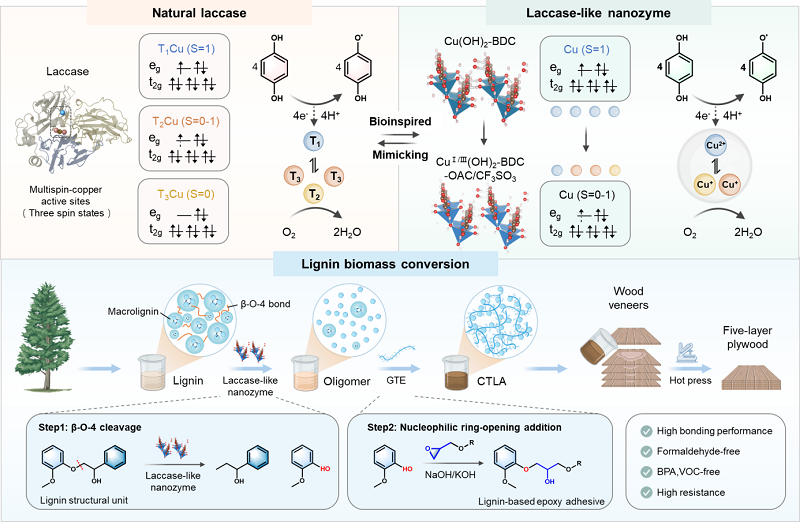
Figure: Schematic illustration of the design of spin-engineered nanozymes and their application in lignin degradation and green adhesive fabrication.
(Image by FAN Kelong's group)
Article link: https://doi.org/10.1002/adma.202517928
Contact: FAN Kelong
Institute of Biophysics, Chinese Academy of Sciences
Beijing 100101, China
E-mail: fankelong@ibp.ac.cn
(Reported by Prof. FAN Kelong's group)