

Double-layered Light-Harvesting Complex of Photosystem I Reveals How Cyanobacteria Adapt to Extreme Iron Starvation
Photosynthesis is the fundamental process that sustains life on Earth. In cyanobacteria, iron stress-induced protein A (IsiA), which is expressed under iron-deficient conditions, assembles around photosystem I (PSI) to form multiple types of PSI-IsiA supercomplexes, thereby enhancing light-harvesting capacity and contributing to the regulation of PSI. Although multilayered PSI-IsiA complexes play a crucial role in cyanobacterial adaptation to environmental stresses, their detailed three-dimensional structures, assembly mechanisms, and energy-transfer pathways have remained poorly understood.
A research team from the Institute of Biophysics of the Chinese Academy of Sciences, Beijing University of Technology, and the University of Liverpool/Ocean University of China employed single-particle cryo-electron microscopy to determine the three-dimensional structures of two distinct PSI-IsiA supercomplexes (PSI3-IsiA43 and PSI1-IsiA13) isolated from the thermophilic cyanobacterium Thermosynechococcus elongatus BP-1 cultured under iron-starved conditions.
The study was published in Nature Communications on December 20, 2025.
The researchers revealed the detailed spatial architecture of double-layered IsiA assemblies encircling either a trimeric or monomeric PSI core, as well as the organization of more than one thousand pigment molecules within these supercomplexes.
Combined with in situ atomic force microscopy (AFM) imaging, the researchers further visualized the native distribution of these PSI-IsiA supercomplexes within thylakoid membranes.
Through in-depth structural analysis of the PSI-IsiA supercomplexes, the researchers elucidated how double-layered IsiA proteins associate with PSI to form stable supramolecular assemblies.
By integrating fluorescence resonance energy transfer (FRET) calculations, they mapped the energy-transfer pathways from the outer IsiA layer to the inner IsiA layer and ultimately to the PSI core, revealing at the three-dimensional structural level the coordinated mechanisms underlying light harvesting and excitation-energy transfer.
Together, these findings provide a molecular framework for understanding how photosynthetic cyanobacteria optimize energy utilization and protect their photosynthetic machinery under iron limitation and other environmental stresses.
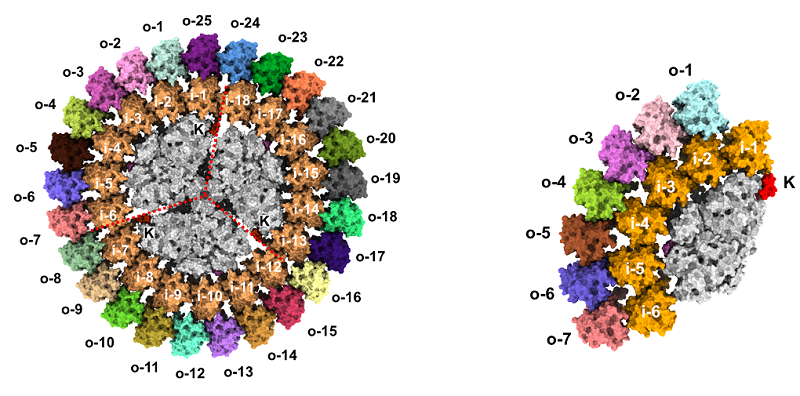
Figure: Cryo-EM structures of the cyanobacterial photosynthetic complexes PSI3-IsiA43 (left) and PSI1-IsiA13 (right)
(Image by LI Mei's group)
Article link: https://www.nature.com/articles/s41467-025-67295-2
Contact: LI Mei
Institute of Biophysics, Chinese Academy of Sciences
Beijing 100101, China
E-mail: meili@ibp.ac.cn
(Reported by Prof. LI Mei's group)