

TransBrain Offers New Framework for Cross-Species Brain Mapping
Over tens of millions of years of evolution, the primate brain underwent extensive reorganization compared with rodents, with particularly pronounced expansion and functional specialization in the cerebral cortex. How to establish a quantitative comparative bridge between humans and mice has long posed a central challenge to neuroscientists.
Recently, a research team led by Profs. LI Ang and WANG Xiaoqun at the Institute of Biophysics of the Chinese Academy of Sciences, developed a computational framework named TransBrain, achieving for the first time high-precision mapping of whole-brain phenotypes between humans and mice.
The study was published in Nature Methods on 29 December 2025.
By systematically integrating whole-brain spatial transcriptomic data, connectomic data and anatomical hierarchy information, the researchers used artificial intelligence and graph-based modeling to construct a quantitative framework for cross-species comparison.
Starting from spatial transcriptomic data covering the entire human and mouse brain, the researchers adopted a detached deep learning strategy to establish a molecular basis for cross-species homology. They further revealed conserved organizational principles across cortical regions, providing molecular underpinnings for translating phenotypes across species.
The researchers treated brain regions from different species as nodes in a graph model. Intraspecies edges were weighted using mouse viral tracer-based connectivity data and human diffusion tractography-derived connectomes, while cross-species edges were weighted by transcriptional similarity under coarse-scale anatomical hierarchical constraints, thereby constructing a heterogeneous cross-species graph.
Finally, using the TransBrain translation tool, the researchers demonstrated representative application scenarios, completing several cross-species quantitative analyses that were previously difficult to perform.
The introduction of the TransBrain framework ushers cross-species studies into a new stage characterized by quantitative and systematic modeling. TransBrain is expected to play an important role in multiple directions: predicting how drug-induced network changes observed in animal models may manifest in humans, matching distinct biological subtypes of psychiatric disorders with the most suitable mouse models, and translating causally defined neural circuit findings in mice into mechanistic insights into human cognitive functions, thereby contributing to the development of precision psychiatry.
In addition, the framework may serve as an important reference for constructing homology mapping methods across more species. TransBrain has been fully open-sourced for the global research community.
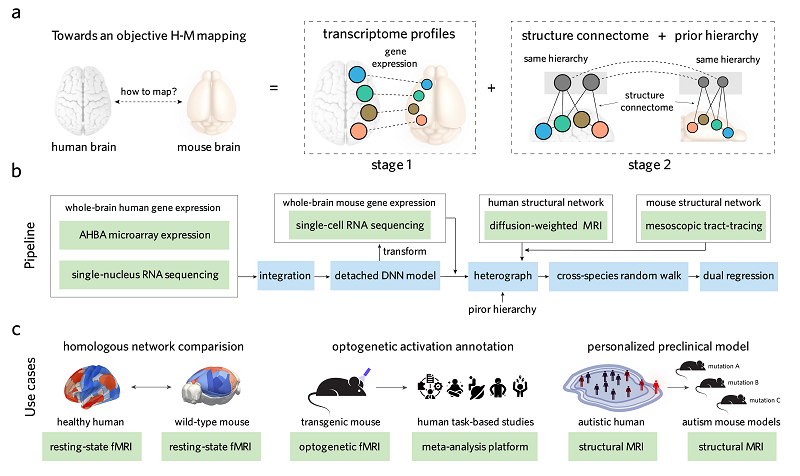
Figure: Schematic overview of the TransBrain framework
(Image by LI Ang's group)
Article link: https://www.nature.com/articles/s41592-025-02961-3
Contact: LI Ang
Institute of Biophysics, Chinese Academy of Sciences
Beijing 100101, China
E-mail: al@ibp.ac.cn
(Reported by Prof. LI Ang's group)