

LEPROTs Control Golgi Passage to Regulate Signaling Receptor Activation
The time that transmembrane (TM) signaling receptors spend in the Golgi directly determines their maturation and, consequently, their efficiency in transmitting signals at the plasma membrane. How cells ensure that these receptors remain in the Golgi for "just the right amount of time," neither exiting prematurely nor lingering excessively, and whether specialized regulatory molecules control this process, has remained largely unclear.
On January 23, 2026, a study published in PNAS by researchers from the Institute of Biophysics of the Chinese Academy of Sciences, and the Hong Kong University of Science and Technology revealed that the transient retention of signaling receptors in the Golgi is coordinated by LEPROT and LEPROTL1, a class of COPI cargo receptors. This discovery uncovers a previously unrecognized regulatory pathway for the maturation of TM receptors.
Using GLIM localization and knockout-rescue experiments, the researchers found that LEPROTs are predominantly localized to the cis-medial Golgi, where they also help maintain Golgi structure. Biochemical interaction assays further showed that LEPROTs directly bind COPI coats via a conserved WxxW motif and rely on COPI-dependent mechanisms to remain in the Golgi.
The researchers then performed vesicle budding assays and mass spectrometry, which identified LEPROTs as COPI cargo receptors that co-package specific signaling receptors. Protein interaction analyses and RUSH trafficking experiments demonstrated that LEPROTs selectively recognize TM domains of appropriate length, capturing receptors at the trans-Golgi and releasing them at the cis-Golgi in a pH-dependent manner via COPI retrieval.
Functional studies revealed that this Golgi retention is critical for receptor maturation. Measurements of glycosylation, palmitoylation, signaling responses, and receptor localization showed that LEPROTs control TM receptor activity by promoting proper Golgi residency and post-Golgi modification.
This work provides the first direct evidence that dedicated COPI cargo receptors regulate the residence time of TM signaling receptors along the anterograde endomembrane pathway (ER → Golgi → plasma membrane). It also broadens the known functional scope of COPI cargo receptors: previously thought to primarily regulate Golgi-resident enzymes, they are now shown to directly influence the maturation and activity of signaling receptors.
These findings offer a new molecular framework for understanding how TM receptor trafficking is regulated and suggest potential strategies for modulating receptor activity in human diseases.
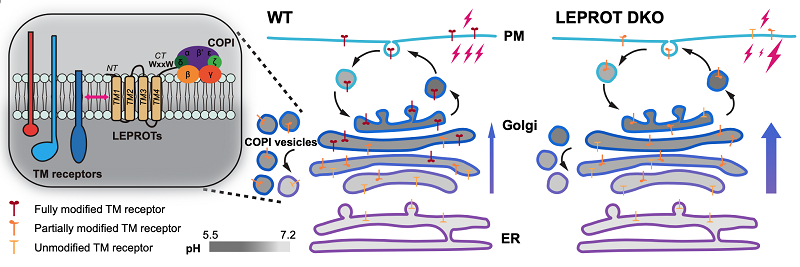
Figure: Schematic of LEPROTs regulating the modification of TM receptors
(Image by HU Junjie's group)
Article link: https://www.pnas.org/doi/10.1073/pnas.2512723123
Contact: HU Junjie
Institute of Biophysics, Chinese Academy of Sciences
Beijing 100101, China
E-mail: huj@ibp.ac.cn
(Reported by Prof. HU Junjie's group)