

What's the Right Regiment for Consuming Goji Berries?
Can the popular habit of steeping a few goji berries in a thermos bottle really deliver the traditional bone- and muscle-strengthening benefits attributed to goji berries?
On June 4, 2026, the research group led by Prof. CHEN Chang at the Institute of Biophysics of the Chinese Academy of Sciences, published a study in The Journal of Nutrition that, for the first time, systematically compared the protective effects of a laboratory-prepared Lycium barbarum (goji berry) extract with those of three common daily consumption methods on bone and muscle health in naturally aged mice.
The study demonstrates that how goji berries are consumed determines whether they can exert their traditional "bone- and muscle-strengthening" effects.
The researchers selected three typical modes of daily goji berry consumption: (1) drinking a hot-water infusion prepared from a small handful of goji berries (approximately 15 berries); (2) drinking the infusion and consuming the rehydrated berries afterward; and (3) eating a handful of dried goji berries directly as a snack.
These approaches were evaluated for their potential protective effects on bone and muscle in aging mice. A concentrated goji berry extract, which the group had confirmed to possess musculoskeletal protective effects and a well-defined preparation process, was used as a positive control.
Using a natural aging mouse model, the researchers established six experimental groups: an adult control group, an aging model group, an aging model treated with goji berry extract, an aging model receiving hot-water infusion without residue, an aging model receiving both the infusion and the soaked berries, and an aging model receiving whole dried berries. All mice were treated for 16 consecutive weeks.
The results showed that none of the three simulated daily consumption methods improved the age-related decline in bone mineral density, bone microarchitecture, or muscle endurance observed in naturally aged mice. In contrast, the concentrated goji berry extract significantly improved all of these parameters.
This study provides a direct experimental answer to a common question: Do these typical daily regiments of consuming goji berries actually work? The findings indicate that conventional low-dose goji berry consumption is insufficient to achieve the traditional bone- and muscle-strengthening benefits attributed to the fruit.
The work not only provides scientific evidence for the question "What is the right way to consume goji berries?" but also serves as a reminder that simply "drinking goji berry tea" is inadequate for bone and muscle health.
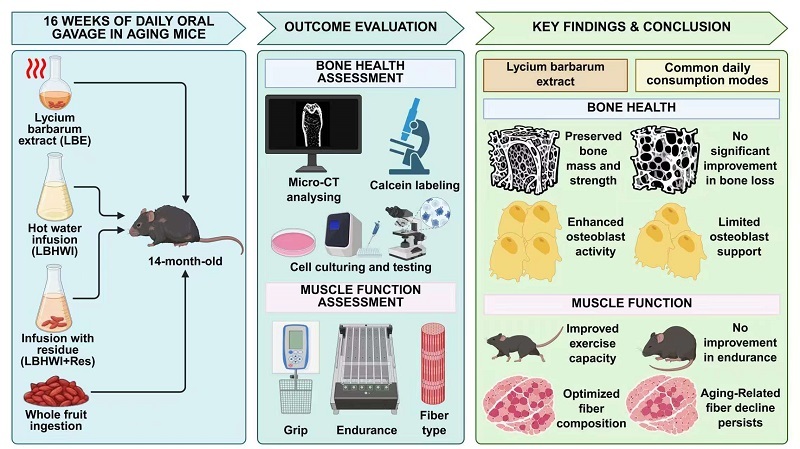
Figure. Schematic Illustration of the Study
(Image by Chen Chang's group)
Article link: https://www.sciencedirect.com/science/article/abs/pii/S0022316626002944
Contact: CHEN Chang
Institute of Biophysics, Chinese Academy of Sciences
Beijing 100101, China
E-mail: changchen@ibp.ac.cn
(Reported by Prof. CHEN Chang's group)