

Scientists uncover neuronal mechanisms for orchestrating muscle autophagy
Autophagy, an evolutionarily conserved lysosomal degradation pathway, is essential for maintaining muscle homeostasis and integrity by removing protein aggregates and damaged organelles that arise from persistent mechanical and metabolic stresses. Both hyperactivation and deficiency of autophagy drive the development of myopathies. Notably, muscle biopsies from individuals with neurogenic disorders such as amyotrophic lateral sclerosis (ALS) and spinal muscular atrophy (SMA) frequently accumulate p62, a well known autophagy substrate. These observations indicate that autophagy in skeletal muscle is under the control of neuron to muscle signals; however, the specific neuronal factors that mediate this non autonomous regulation remain elusive.
A research group led by Prof. ZHANG Hong at the Institute of Biophysics, Chinese Academy of Sciences, has identified two parallel neuronal circuits that govern the autophagy lysosome pathway in the body wall muscle (BWM) of C. elegans. The study was published online in Developmental Cell on June 29, 2026.
The researchers revealed that heterotypic gap junctions composed of UNC 7 in AVA command interneurons and UNC 9 in A type motor neurons (A MNs) regulate autophagic activity in BWM through neuropeptide signaling. These UNC 7/UNC 9 gap junctions negatively control the release of the neuropeptides NLP 12, NLP 9, and FLP 18 from A MNs. NLP 12 and FLP 18 subsequently engage the G protein coupled receptor NPR 5 on the BWM plasma membrane, which in turn activates the Gαq/EGL 30 cascade. The researchers also found that the TGFβ like molecule DAF 7, secreted by ASI sensory neurons, modulates autophagy in BWM. Both pathways converge to maintain intracellular calcium homeostasis. Perturbation of either signaling route elevates intracellular Ca2+, causing aberrant activation of calpain proteases. This impairs lysosomal function, leading to the accumulation of non degradative autolysosomes and ultimately to BWM degeneration.
This study elucidates how neuronal signals are transmitted and decoded by muscle cells to control autophagy, preserve muscle integrity and physiological function, and provides new insights into the pathogenesis of neurogenic myopathies.
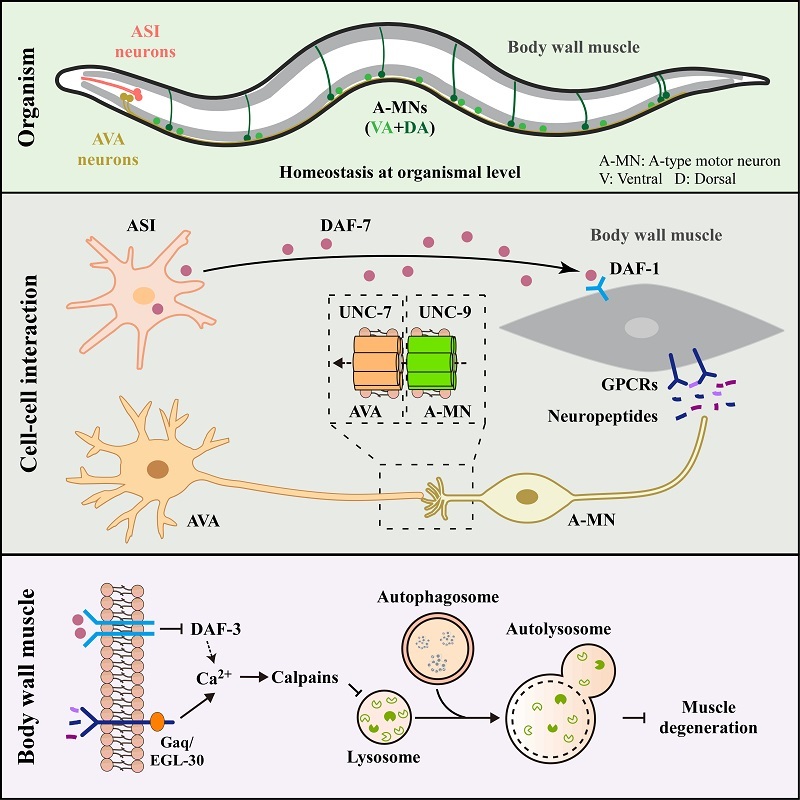
Fig. Model for how neuron-to-muscle singling orchestrates muscle autophagy and homeostasis
(Image by ZHANG Hong's group)
Article link: https://doi.org/10.1016/j.devcel.2026.06.001
Contact: ZHANG Hong
Institute of Biophysics, Chinese Academy of Sciences
Beijing 100101, China
E-mail: hongzhang@ibp.ac.cn
(Reported by Prof. ZHANG Hong's group)