

Novel Antithrombotic Strategy Targeting Platelet Ero1α-PDI Pathway
Cardiovascular disease remains a leading cause of death worldwide, with thrombosis at its core. Current antiplatelet drugs effectively prevent thrombotic events but carry a significant risk of bleeding, creating an urgent need for safer alternatives.
In a recent study, the research groups of Prof. WANG Lei and Prof. JIANG Tao from the Institute of Biophysics, Chinese Academy of Sciences (CAS), in collaboration with Prof. FANG Chao from Huazhong University of Science and Technology, reported that two clinical-stage anticancer compounds-Luminespib and AZ5104-can be repurposed as potent antithrombotic agents by targeting the platelet Ero1α-PDI oxidative folding system, without increasing bleeding risk.
Protein disulfide isomerase (PDI) is a key regulator of integrin αIIbβ3 activation on the platelet surface. The WANG laboratory previously proposed that targeting the specific interface between PDI and its upstream oxidase Ero1α as a new therapeutic strategy for related diseases. Following this concept, the team designed a three-tiered high-throughput screening platform and identified Luminespib and AZ5104 from an FDA-approved compound library. Remarkably, rather than attacking the active site, these compounds bind reversibly to a unique hydrophobic pocket of PDI, allosterically disrupting the Ero1α-PDI functional interaction while leaving other PDI family members unaffected.
In platelets, both compounds dose-dependently inhibit integrin αIIbβ3 activation and clot retraction. In platelet-specific Pdi or Ero1a knockout mice, their antiplatelet effects are almost completely abolished-demonstrating on-target specificity. In mouse models, both compounds significantly suppress thrombus formation without prolonging tail bleeding time, a critical safety feature.
This study not only identifies Luminespib and AZ5104 as promising antithrombotic drug candidates but also validates allosteric inhibition of the Ero1α-PDI interface as a new strategy that balances efficacy and safety. Given that the Ero1α-PDI system is also a promising anticancer target, these compounds may offer synergistic benefits for cancer patients at high risk of thrombosis.
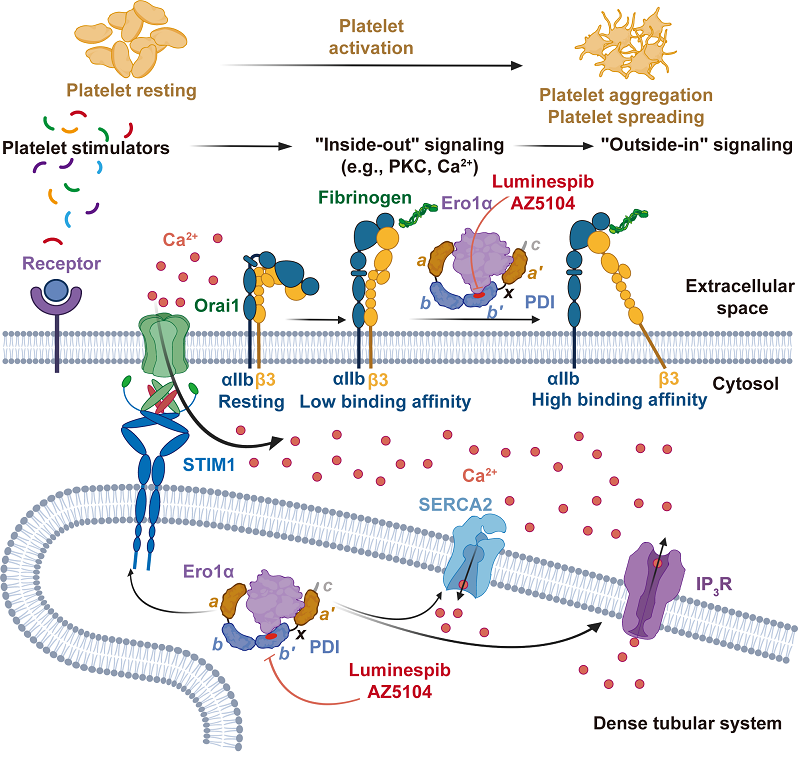
Figure. A model illustrating the mechanism of platelet inhibition by Luminespib and AZ5104
(Image by WANG Lei's group)
Article link: https://www.science.org/doi/10.1126/sciadv.aeg2095
Contact: WANG Lei
Institute of Biophysics, Chinese Academy of Sciences
Beijing 100101, China
E-mail: wanglei@ibp.ac.cn
(Reported by Prof. WANG Lei's group)