

How protein phosphorylation in the Golgi apparatus affects breast milk quality
Milk is the sole source of nutrition for newborn mammals, and much of its nutritional value comes from casein micelles. The assembly of these micelles depends on extensive phosphorylation of casein proteins. Though phosphorylated casein was first identified as early as 1883, its upstream protein kinase Fam20C was only reported recently. How Fam20C efficiently phosphorylates caseins and other secretory proteins remains elusive.
In a study published in the Journal of Cell Biology, the research group led by Prof. WANG Lei from the Institute of Biophysics, Chinese Academy of Sciences, uncovered a mechanism whereby Golgi retention of Fam20 kinases ensures robust phosphorylation of secretory proteins during lactation.
Building on their previous discovery that Fam20C is synthesized as a type II transmembrane protein and undergoes proteolytic activation via site-1 protease cleavage within the Golgi apparatus, the researchers found that Fam20A, a paralog of Fam20C, is also a transmembrane protein, and forms a heretocomplex with Fam20C. The transmembrane domain of Fam20A anchors mature, catalytically active Fam20C on the Golgi membrane, prolonging its Golgi residence time and thereby enhancing substrate phosphorylation.
The researchers also identified the cargo receptors ERGIC2 and ERGIC3 as key factors mediating the trafficking of Fam20A-Fam20C complex from the endoplasmic reticulum to the Golgi. Notably, both ERGIC2-ERGIC3 and Fam20A-Fam20C are markedly upregulated in the mammary glands of lactating mouse, highlighting their physiological relevance during lactation. Indeed, Ergic2 or Ergic3 knockout mice display global changes in secretome phosphorylation, less phosphorylated β-casein in milk and deficiency on offspring growth.
Collectively, these findings reveal how the intracellular trafficking and localization of secretory pathway kinases are finely tuned to facilitate robust protein phosphorylation in the Golgi. The study provides new insights into the molecular mechanisms that govern breast milk quality and lays a foundation for future efforts to improve dairy products.
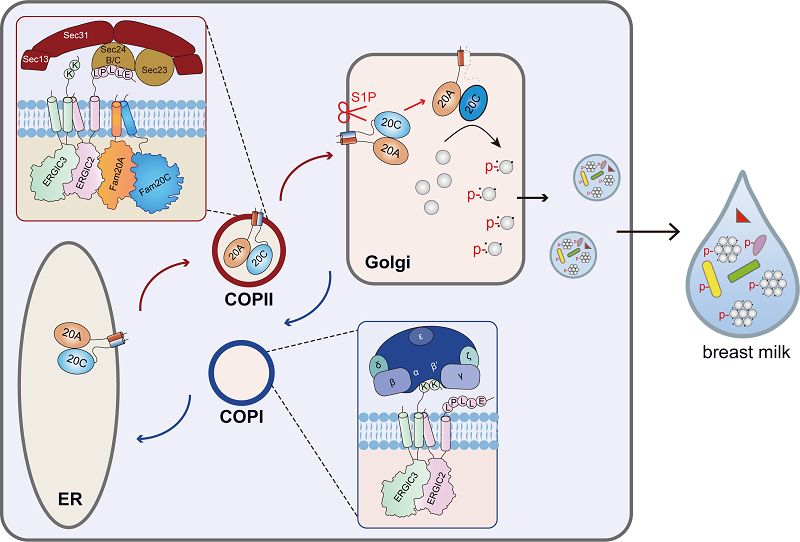
Figure. A model of how cargo receptor ERGIC2-ERGIC3 mediates Golgi localization of Fam20A-Fam20C kinase complex during lactation
(Image by WANG Lei's group)
Article link: https://rupress.org/jcb/article/225/8/e202507107/282832
Contact: WANG Lei
Institute of Biophysics, Chinese Academy of Sciences
Beijing 100101, China
E-mail: wanglei@ibp.ac.cn
(Reported by Prof. WANG Lei's group)