

Scientists Discover Active Modulation of Visual Sensitivity During Attention Shifts
Our brains constantly shift attention from one object or location to another, allowing us to efficiently explore the visual world. A new study published in PNAS on June 30, 2026, led by Prof. HE Sheng's group at the Institute of Biophysics of the Chinese Academy of Sciences, has revealed that these shifts are accompanied by a brief suppression of visual processing.
Interactions between the brain and the external world are not limited to overt physical movements. They also occur within the brain's internal cognitive space through covert shifts of attention.
Do these internal attention shifts also trigger active modulation of perceptual sensitivity?
Addressing this question first requires identifying the precise moments when attention shifts occur, despite the absence of any observable movement.
To overcome this challenge, the researchers took advantage of rhythmic attentional oscillations. By densely sampling attentional states over time and characterizing the periodic spatial dynamics of attention, they were able to predict the timing of attention shifts with millisecond precision.
A second challenge was how to measure visual sensitivity without disrupting the attentional process itself. Any probe used to assess visual sensitivity could potentially interfere with the ongoing allocation of attention.
To avoid this problem, the researchers presented task-irrelevant visual probes at different moments during the attention cycle and recorded the evoked pupil responses and neural activity using pupillometry and magnetoencephalography (MEG). This passive measurement strategy allowed them to track changes in visual sensitivity without altering the natural dynamics of attention.
The researchers found that the brain transiently suppresses visual sensitivity during attention shifts. This active suppression occurs primarily in higher-order cortical regions, particularly the parietal cortex, suggesting that it is an integral component of the brain's attentional network.
The findings further suggest that active regulation of perception may be a shared property of neural systems across different levels of cognition, enabling the brain to maintain stable and efficient processing both during interactions with the external world and during internal shifts of cognitive states.
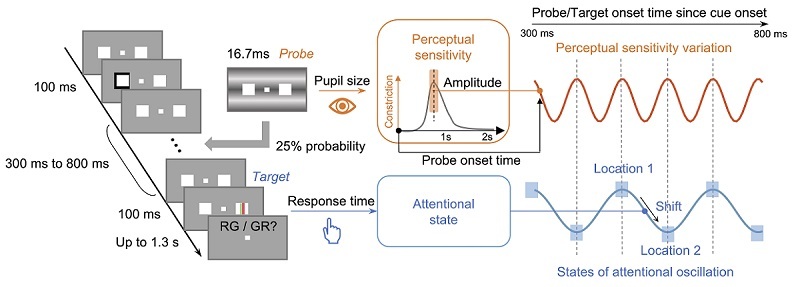
Figure: Measuring visual sensitivity across different attentional states using pupillometry and the attentional oscillation paradigm.
(Image by HE Sheng's group)
Article link: https://www.pnas.org/doi/epdf/10.1073/pnas.2530939123
Contact: HE Sheng
Institute of Biophysics, Chinese Academy of Sciences
Beijing 100101, China
E-mail: shenghemn@gmail.com
(Reported by Prof. HE Sheng's group)