

Scientists Reveal How hnRNPK Condensates Orchestrate Enhancer-Promoter RNA Interactions to Activate Gene Transcription
Enhancers are distal DNA regulatory elements that activate gene expression by establishing long-range interactions with their target promoters through chromatin looping. Although DNA-binding transcription factors and chromatin architectural proteins have traditionally been viewed as the primary drivers of enhancer-promoter communication, recent studies have revealed an additional layer of regulation mediated by enhancer RNAs (eRNAs) and promoter-associated upstream antisense RNAs (uaRNAs, also known as PROMPTs). These regulatory RNAs can form direct RNA-RNA interactions between enhancers and promoters; however, how these RNA interactions are converted into productive transcriptional activation has remained a fundamental unanswered question.
A research team led by XUE Yuanchao at the Institute of Biophysics, Chinese Academy of Sciences, has now uncovered a previously unrecognized mechanism by which the RNA-binding protein heterogeneous nuclear ribonucleoprotein K (hnRNPK) coordinates enhancer-promoter RNA-RNA interactions and RNA polymerase II (Pol II) recruitment to activate gene transcription. Their findings were published in Nature Genetics.
To elucidate the molecular basis of this process, the researchers combined multiple advanced approaches, including RNA in situ conformation sequencing (RIC-seq), HiChIP, CUT&Tag, live-cell super-resolution imaging, in vitro phase-separation reconstitution, and genetically engineered mouse models of human developmental disease.
The study demonstrates that hnRNPK preferentially associates with nascent eRNAs and uaRNAs at active regulatory elements, where it promotes genome-wide enhancer-promoter looping. Acute depletion of hnRNPK markedly weakens enhancer-promoter interactions, impairs RNA polymerase II recruitment, and leads to widespread transcriptional repression, establishing hnRNPK as a central regulator of long-range gene activation.
A major discovery of the study is that hnRNPK undergoes liquid-liquid phase separation to form a previously unrecognized type of cavity-containing condensate (Fig. 1a). These condensates directly recruit and encapsulate Pol II through interaction with its core subunit RPB3. Importantly, paired eRNAs and uaRNAs further enhance Pol II enrichment within hnRNPK condensates and promote hnRNPK dimerization, thereby enabling the directional transfer of Pol II from enhancer regions to promoters and facilitating efficient transcriptional activation (Fig. 1b).
"Our findings reveal that hnRNPK functions as a previously unrecognized molecular hub that integrates RNA interactions, three-dimensional chromatin architecture, and the transcription machinery to coordinate enhancer-driven gene activation. " XUE explained.
The study also establishes the physiological relevance of this mechanism. Disease-associated hnRNPK mutations identified in patients with Au-Kline syndrome abolish the normal liquid-like properties of hnRNPK condensates, causing them to transition into aberrant gel-like assemblies. This defect disrupts enhancer-promoter communication, compromises Pol II recruitment, and broadly suppresses developmental gene expression. Consistently, mice carrying the pathogenic mutation exhibit severe growth retardation and craniofacial abnormalities that closely resemble the clinical manifestations of Au-Kline syndrome.
By integrating RNA-mediated interactions, phase-separated condensates, three-dimensional genome organization, and transcriptional machinery recruitment into a unified regulatory framework, this study provides a new understanding of how enhancer-derived regulatory information is transmitted to promoters. The findings establish RNA-guided phase-separated condensates as a critical bridge linking three-dimensional genome organization to transcriptional output and provide new insights into the molecular basis of developmental disorders caused by defects in enhancer-promoter communication.
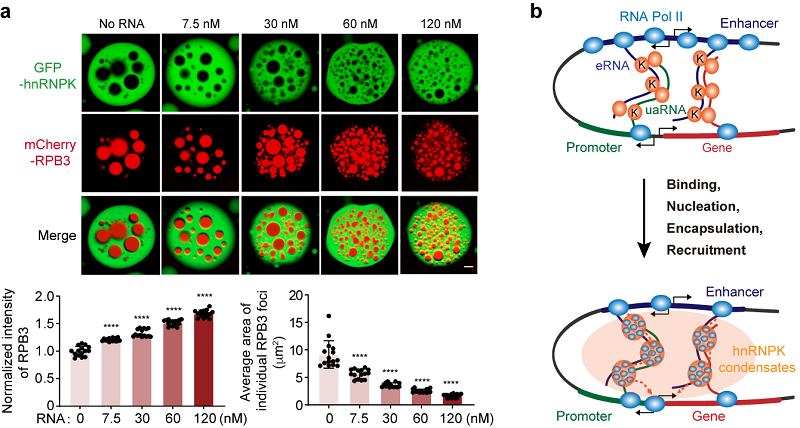
Figure 1. HnRNPK condensates promote enhancer-promoter looping and Pol II recruitment. a, Pooled eRNAs and uaRNAs enhance the encapsulation of RPB3 within hnRNPK phase-separated cavity-containing condensates. b, Schematic model illustrating hnRNPK-mediated transcriptional regulation.
(Image by XUE Yuanchao's group)
Article link: https://www.nature.com/articles/s41588-026-02710-y
Contact: XUE Yuanchao
Institute of Biophysics, Chinese Academy of Sciences
Beijing 100101, China
E-mail: ycxue@ibp.ac.cn
(Reported by Prof. XUE Yuanchao's group)