

Computationally Designed Nanoparticle Platform Enhances Influenza Vaccine Immunity
Protein nanoparticles have emerged as a promising vaccine platform because they display antigens in a highly ordered, multivalent manner, thereby enhancing immunogenicity and the durability of protective immune responses. However, many existing nanoparticle scaffolds are limited by scaffold-directed immune responses, suboptimal manufacturability, and restricted structural flexibility, highlighting the need for improved and more versatile antigen-display platforms.
On July 10, 2026, a research team led by Prof. WANG Xiangxi at the Institute of Biophysics of the Chinese Academy of Sciences, in collaboration with Jiangsu Recbio Technology Co., Ltd., published their findings in Protein & Cell.
Using artificial intelligence (AI) to redesign a protein nanoparticle platform, the researchers developed a novel I53cs nanoparticle with independent intellectual property rights and demonstrated its application in influenza vaccine development.
Through the integration of AI-guided protein design, structural characterization, and animal immunization studies, the work established a comprehensive validation framework and provides a new technological strategy for next-generation vaccine development.
The researchers first established a library of protein nanoparticle scaffolds. Using symmetry as the central design principle, they generated higher-order symmetric nanoparticles with diverse geometries through high-dimensional symmetry matching and hierarchical docking based on a single symmetric scaffold.
The candidate scaffolds were subsequently evaluated using structure prediction models, including AlphaFold and RosettaFold, together with sequence-design algorithms such as ProteinMPNN and SCUBA for sequence optimization and assembly screening. This workflow yielded a series of mature immunopotentiating scaffolds with tunable particle size, symmetry, and antigen-display valency.
Using this strategy, the researchers successfully constructed multiple nanoparticle architectures, including octahedral, icosahedral, and double-layer symmetric assemblies. The designed nanoparticles span diameters of approximately 24-32 nm and support 48 to 120 copies of displayed antigens, providing a modular and customizable platform that can accommodate diverse antigens and immunization requirements.
Building on this platform, the researchers generated monovalent, trivalent, and mosaic nanoparticle vaccines displaying the hemagglutinin (HA) proteins of H1N1, H3N2, and influenza B/Victoria viruses.
Animal studies demonstrated that the I53cs platform rapidly elicited high levels of hemagglutination-inhibition antibodies. Compared with soluble HA proteins and a licensed trivalent inactivated influenza vaccine, the nanoparticle vaccines induced stronger and more durable antibody responses while simultaneously generating broad immunity against multiple influenza strains.
These findings highlight the promise of the I53cs platform as a versatile technology for developing next-generation influenza vaccines.
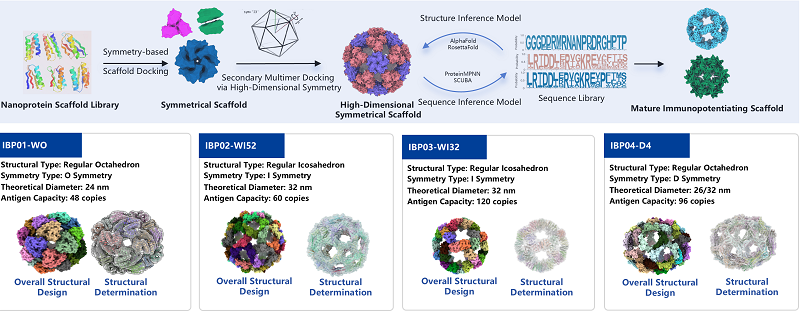
Figure 1. AI-driven design of a universal protein immunogenic scaffold platform and development of a novel nanoparticle scaffold.
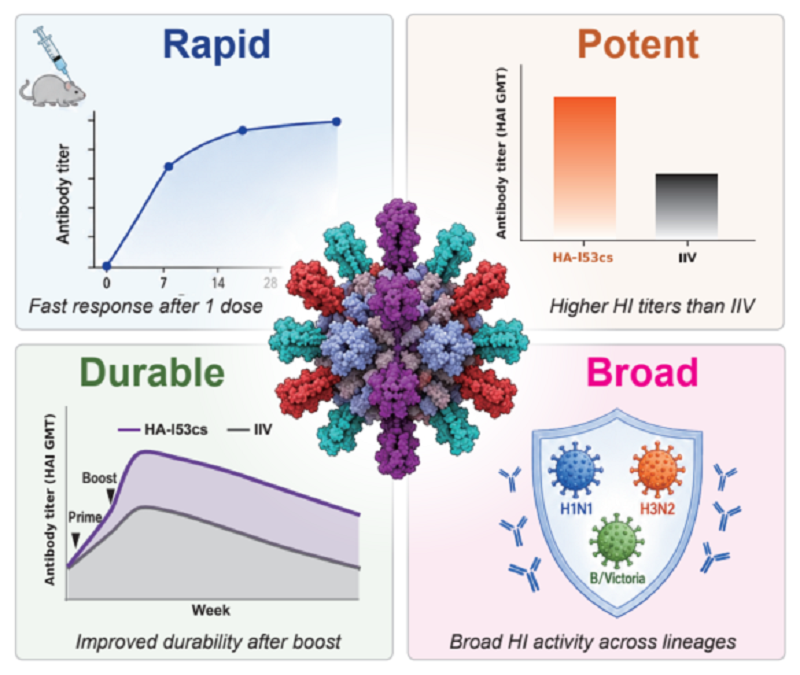
Figure 2. AI-designed protein nanoparticles enable multivalent display of influenza HA antigens, eliciting faster, stronger, more durable, and broader antibody responses.
(Image by WANG Xiangxi's group)
Article link:
https://academic.oup.com/proteincell/advance-article/doi/10.1093/procel/pwag046/8731965?login=false
Contact: WANG Xiangxi
Institute of Biophysics, Chinese Academy of Sciences
Beijing 100101, China
E-mail: xiangxi@ibp.ac.cn
(Reported by Prof. WANG Xiangxi's group)