

Scientists Uncover How the Brain Deviates from Criticality in Disorders of Consciousness
Disorders of consciousness (DoC), caused by severe brain injury, present major challenges for clinical diagnosis, treatment, and prognosis. The theory of brain criticality proposes that the healthy brain operates near a critical point between order and disorder, enabling optimal information processing and neural integration. However, whether the brains of DoC patients deviate from this critical state, and how such deviations relate to metabolic dysfunction and impaired consciousness, has remained largely unknown.
Recently, a research team from the Institute of Biophysics of the Chinese Academy of Sciences and Beijing Tiantan Hospital, Capital Medical University, combined resting-state functional magnetic resonance imaging (rs-fMRI) and positron emission tomography (PET) to systematically investigate alterations in brain criticality in patients with DoC from the perspectives of neural dynamics and energy metabolism.
The study was published in Communications Biology on July 20, 2026.
The researchers characterized brain criticality using complementary metrics, including the power-law scaling exponent of co-activation clusters, Ising model-based dynamical measures, and phase synchronization.
Compared with patients in a minimally conscious state (MCS), patients with unresponsive wakefulness syndrome (UWS) exhibited higher power-law scaling exponents and Ising energy, together with lower phase synchronization. These findings indicate that the brains of UWS patients deviate further from the critical state and shift toward a more suppressed, subcritical regime.
In this subcritical state, neural activity becomes less capable of sustaining large-scale propagation and long-range communication, leading to reduced information integration and a diminished dynamic range.
Further analyses revealed that regional differences in criticality metrics between UWS and MCS patients were significantly correlated with regional differences in cerebral glucose metabolism, providing metabolic evidence for the observed abnormalities in brain dynamics.
The researchers further integrated three whole-brain criticality metrics into a support vector machine (SVM) classifier. The model achieved an accuracy of 92.31% in distinguishing UWS from MCS patients and 76.00% in predicting clinical outcomes, outperforming PET-based metabolic measures.
By characterizing DoC from the perspective of large-scale brain dynamics, this study provides new insights into the neural mechanisms underlying impaired consciousness and identifies brain criticality as a promising framework for developing objective tools for diagnosis and prognosis.
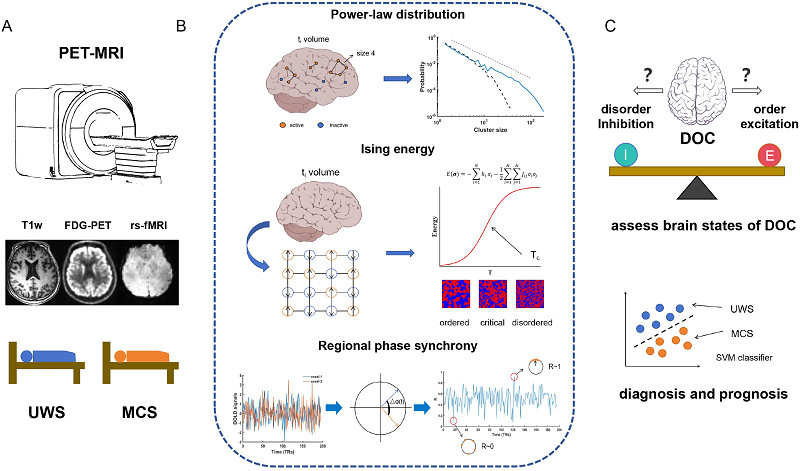
Figure 1. Study workflow
(Image by LIU Ning's group)
Article link: https://www.nature.com/articles/s42003-026-10713-y
Contact: LIU Ning
Institute of Biophysics, Chinese Academy of Sciences
Beijing 100101, China
E-mail: liuning@ibp.ac.cn
(Reported by Prof. LIU Ning's group)