

Humanized Antibody QX007N Shows Promise for Treating IL-33-Driven Airway Inflammation
Interleukin-33 (IL-33) is a key regulator of immune responses and has been implicated in a range of inflammatory and allergic diseases, including asthma and chronic obstructive pulmonary disease (COPD). However, the molecular mechanisms by which therapeutic antibodies neutralize IL-33 remain incompletely understood.
On September 18, 2026, a research team led by Prof. FENG Wei at the Institute of Biophysics of the Chinese Academy of Sciences, in collaboration with QX Biopharmaceuticals, published a research article in Structure. The study identified QX007N, a humanized monoclonal antibody that targets IL-33 and effectively inhibits its biological activity, and further uncovered how the antibody interferes with IL-33 receptor signaling.
The researchers first evaluated the activity of QX007N in cellular systems. The antibody strongly inhibited signaling triggered by IL-33 and showed potent neutralizing activity across multiple experimental assays. Its efficacy was also assessed in B-hIL-33 humanized mice with acute allergic airway inflammation. The results demonstrated that QX007N can suppress IL-33-driven allergic inflammation in vivo.
To elucidate the molecular basis of QX007N-mediated neutralization, the researchers determined high-resolution crystal structures of the QX007N antigen-binding fragment (Fab) alone and its complex with IL-33, at resolutions of 2.62 Å and 2.60 Å, respectively. Structural analysis revealed that QX007N recognizes epitope 2 on IL-33, which partially overlaps with the ST2-binding surface.
Further structural comparison showed that QX007N binding would sterically interfere with the productive assembly of the IL-33/ST2/IL-1RAcP signaling complex. Biochemical competition experiments further demonstrated that QX007N interferes with the interaction between IL-33 and ST2. These findings indicate that QX007N neutralizes IL-33 primarily by preventing the formation of the functional receptor signaling complex, thereby blocking downstream signal transduction.
By integrating structural, biochemical, cellular, and in vivo analyses, the study provides a molecular framework for understanding the neutralizing mechanism of QX007N. The findings establish QX007N as a potent epitope 2-directed IL-33-neutralizing antibody and support its further development as a potential therapeutic candidate for asthma, COPD, and other inflammatory diseases driven by dysregulated IL-33 signaling.
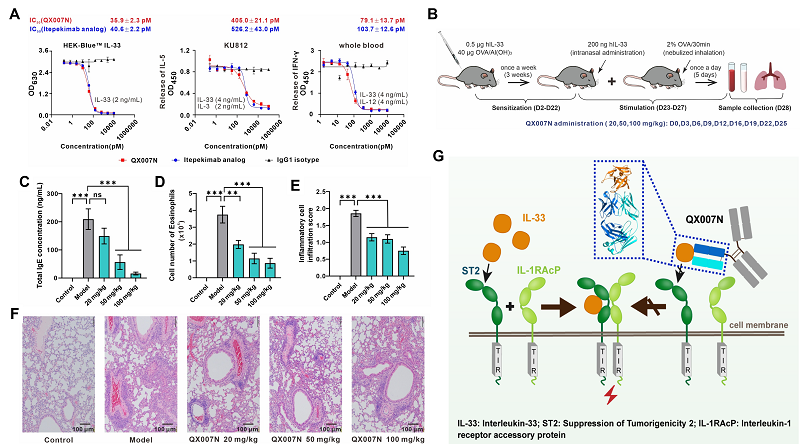
Figure 1. Neutralizing activity of the humanized monoclonal antibody QX007N against IL-33-mediated signaling and its proposed mechanism of action
(Image by FENG Wei's group)
Article link: https://doi.org/10.1016/j.str.2026.08.012
Contact: Feng Wei
Institute of Biophysics, Chinese Academy of Sciences
Beijing 100101, China
E-mail: wfeng@ibp.ac.cn
(Reported by Prof. FENG Wei's group)