

Liu Ning's Group and Collaborators Reveal Evolutionary Reorganization of the Self-Processing Network across Primates
Self-processing is a core cognitive function that enables individuals to integrate internal bodily states, external sensory information, and socially relevant signals into a coherent representation of the self. Previous studies have proposed that self-processing comprises several interrelated levels, including interoceptive processing, exteroceptive processing, and mental-self processing. Humans, chimpanzees, and macaques show marked differences in self-related behaviors, yet it remains unclear which neural substrates underlying these behaviors are evolutionarily conserved and which have undergone reorganization.
Recently, LIU Ning's group at the Institute of Biophysics, Chinese Academy of Sciences, together with collaborators, published a study entitled "Evolutionary Reorganization of the Self-Processing Network across Primates" in The Journal of Neuroscience. Using a comparative connectomics framework, the researchers analyzed neuroimaging data from 46 humans, 46 chimpanzees, and 43 macaques. The study was based on a previously established meta-analysis-derived human self-processing network (SPN). Forty-two homologous white-matter tracts shared across the three species were used to construct a cross-species homologous connectivity space, through which the human SPN was mapped onto chimpanzee and macaque cortex. The researchers then compared local microstructural and transcriptional features between humans and macaques, and further examined large-scale structural connectivity across all three species.
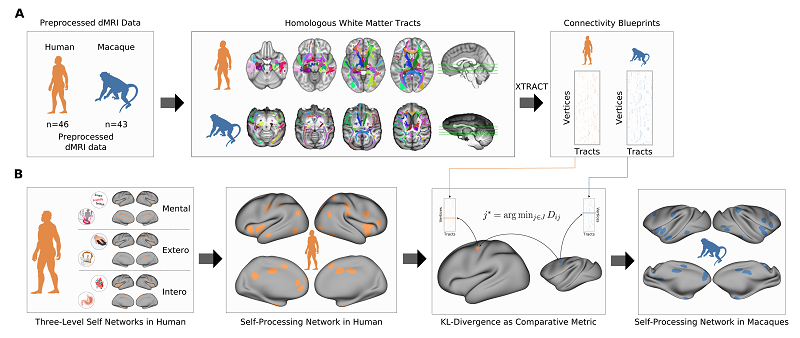
Figure 1. Cross-species mapping framework of the self-processing network based on connectivity fingerprints of homologous white-matter tracts
(Image by LIU Ning's group)
The results showed that humans and macaques exhibited highly similar spatial profiles of T1w/T2w-derived myelin-sensitive contrast within the SPN. Gene-expression patterns associated with these regional microstructural variations were also partially conserved across the two species and were significantly enriched for human-accelerated brain-related genes. In contrast to this relative conservation of local biological features, the large-scale structural connectivity of the SPN showed pronounced species-related reorganization, with chimpanzees generally occupying an intermediate position between macaques and humans.
Further analyses revealed that this reorganization was functionally hierarchical. Within the interoceptive-processing subnetwork, macaques and chimpanzees showed the greatest similarity. Within the exteroceptive-processing subnetwork, chimpanzees were more similar to humans. In the mental-self-processing subnetwork, interspecies differentiation became more pronounced. In parallel, small-worldness of the SPN increased progressively from macaques to chimpanzees and humans. Network hubs also showed a systematic spatial shift: they were primarily located in the insula in macaques, involved both insular and cingulate regions in chimpanzees, and were predominantly centered on cingulate regions in humans.
The study therefore reveals a scale-dependent evolutionary organization of the primate SPN, characterized by relative conservation of local biological features together with selective reorganization of large-scale network architecture. It further shows that different levels of self-processing follow distinct cross-species reorganization patterns, providing comparative neuroscientific evidence for understanding the evolution of neural architectures underlying human self-processing.
Article link: https://doi.org/10.1523/JNEUROSCI.0439-26.2026
Contact: Liu Ning
Institute of Biophysics, Chinese Academy of Sciences
Beijing 100101, China
E-mail: liuning@ibp.ac.cn
(Reported by Prof. Liu Ning's group)