

Scientists Reveal How a Lichen Algal Partner Adapts Photosynthesis to Life on Land
Photosystem I (PSI) is a key molecular complex that converts light energy into chemical energy during photosynthesis. While terrestrial plants generally possess smaller PSI antenna systems than their aquatic algal relatives, how this reduction occurred and how PSI protects itself against intense light and other environmental stresses have remained unclear.
A recent study of the lichen-associated green alga Diplosphaera chodatii provides structural clues to these questions, revealing a highly flexible PSI antenna system and distinctive structural and pigment features that may help the alga cope with high light, drought, and other stresses associated with terrestrial habitats.
The research team isolated D. chodatii, the phycobiont of the desert lichen Endocarpon pusillum, and found that its PSI complexes exist in at least four distinct forms that differ in the number of associated LHCI antenna proteins. Using cryo-electron microscopy, the researchers determined the structures of all four PSI complexes.
The most intact complex, DcPSI-8LHCI, contains 13 core subunits and eight Lhca antenna proteins arranged in three belt-like layers: an inner antenna belt composed of an Lhca tetramer, an outer antenna belt formed by an Lhca dimer, and a side antenna belt consisting of another Lhca dimer.
Compared with PSI-10LHCI from the model green alga Chlamydomonas reinhardtii, the PSI complex of D. chodatii lacks two Lhca proteins from the outer antenna layer. However, compared with PSI complexes from land plants, it retains four additional Lhca subunits in the outer and side antenna layers. This antenna configuration therefore represents an intermediate state between the larger antenna systems found in aquatic green algae and the more compact PSI antenna systems of land plants.
The study further revealed that the PSI antenna system of D. chodatii exhibits substantial structural plasticity and possesses distinctive pigment features that resemble those of land-plant PSI. Together, these characteristics may provide a structural basis for coping with terrestrial stresses such as high light and drought, suggesting that D. chodatii and land plants may have undergone convergent evolutionary adaptations to life on land.
Based on these findings, the researchers proposed a gradual model for PSI antenna reduction in green algae during terrestrial adaptation. In this model, the two outer Lhca proteins, Lhca1 and Lhca4, are lost first, followed by the outer Lhca5-Lhca6 dimer and, ultimately, the side-layer Lhca2-Lhca9 dimer.
Overall, the study provides structural evidence for understanding how photosynthetic organisms may have remodeled their photosynthetic machinery during the transition from aquatic to terrestrial environments. It also offers new insights into the adaptive strategies that enable lichen-associated algae to survive and acclimate to challenging terrestrial conditions.
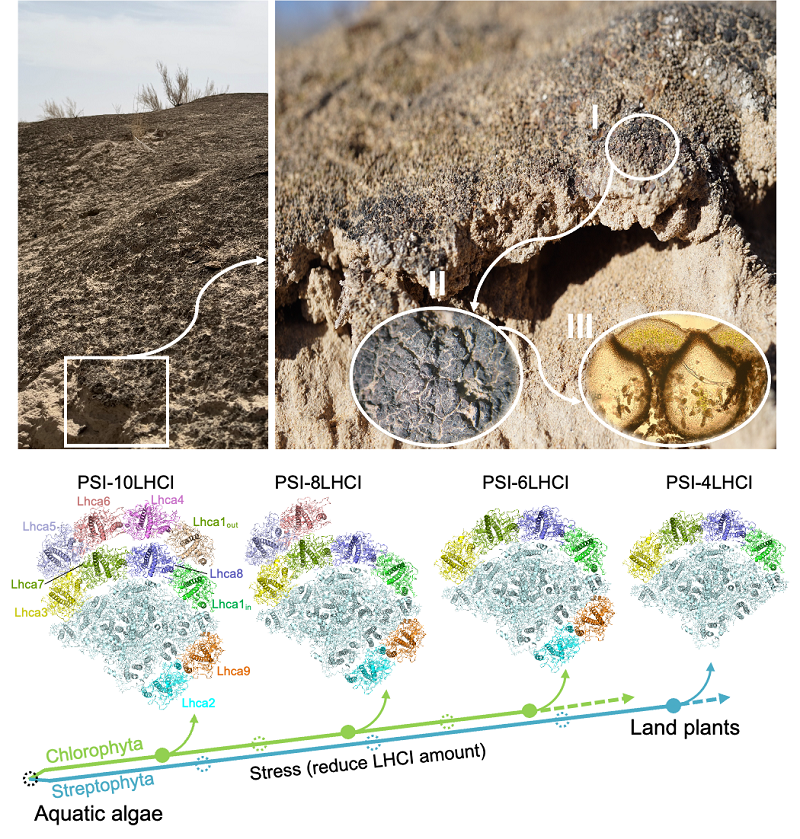
Figure. The phycobiont of Endocarpon pusillum is surrounded by fungal hyphae under intense desert light (top), and a proposed model illustrating the progressive reduction of the light-harvesting antenna system during terrestrial adaptation, potentially reflecting convergent evolution with land plants (bottom).
(Image by LI Mei's group)
Article link: https://www.nature.com/articles/s41467-026-77656-0
Contact: LI Mei
Institute of Biophysics, Chinese Academy of Sciences
Beijing 100101, China
E-mail: meili@ibp.ac.cn
(Reported by Prof. LI Mei's group)