

Intact Primary Visual Cortex Is Needed for Conscious Position Perception
The brain can use motion signals to predict an object's current position, enabling us to respond promptly and accurately. But how does the brain use motion information to "predict" an object's current position and generate visual awareness? The causal relationship between neural activity in the primary visual cortex (V1) and visual awareness has long been controversial.
The research group led by Prof. ZHANG Peng at the Institute of Biophysics of the Chinese Academy of Sciences, together with collaborators, combined brain-lesion patients with a position-illusion paradigm to reveal that feedback signals expressed in V1 are necessary for visual awareness of an object's "predicted" current position.
The findings were published in Cognitive Science Research on October 8, 2026.
The researchers used the flash-grab effect (FGE), a position-illusion paradigm, to dissociate an object's physical position from its perceived position. Experiments were conducted in hemianopic patients with V1 lesions, hemianopic patients with damage to the optic radiation (the white-matter tract from the visual thalamic LGN to V1), and healthy participants.
In the Grab-in condition, V1-lesion patients could not see the red bar "grabbed" into the scotoma and needed the bar to be moved farther outward before they could see it outside the scotoma boundary; in the Grab-out condition, they could see the bar in the intact visual field.
Healthy participants with an "artificial scotoma," as well as patients with optic radiation damage but intact V1, could see the displaced red bar within the blind field. This indicates that when V1 is intact, participants can see a red bar whose position has been displaced by background motion within the blind field.
The study suggests that consciously seeing a stimulus requires V1 to receive position-prediction feedback. When V1 is damaged, higher motion areas may still compute the displaced position, but the feedback cannot reach the corresponding V1 region, so the red bar "disappears" within the blind field; when V1 is intact, the feedback arrives and the displaced bar remains visible.
This study in brain-lesion patients demonstrates that, under attentional conditions, feedback signals from higher cortex to V1 are necessary for visual awareness. The motion-illusion paradigm used in this study has important clinical implications for assessing the specific site of visual pathway damage in patients with visual field defects.
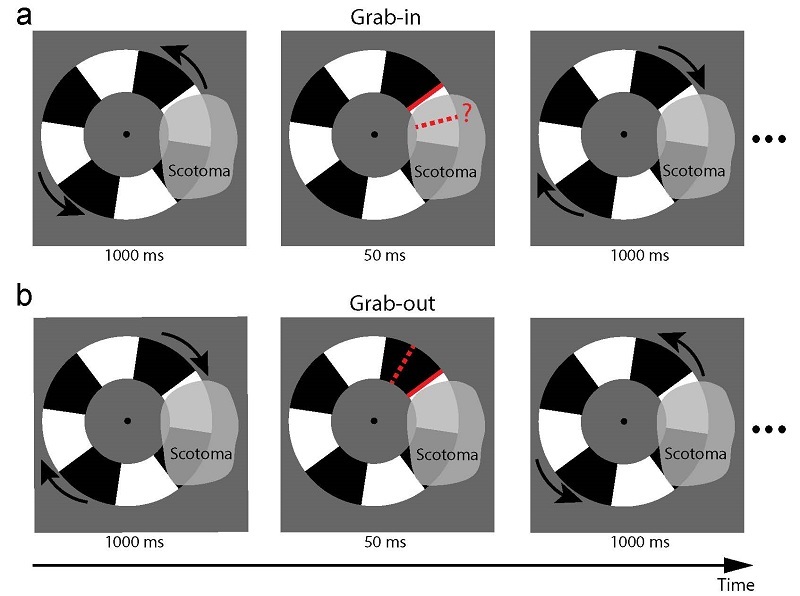
Figure 1. Schematic of flash position shifts under Grab-in and Grab-out conditions.
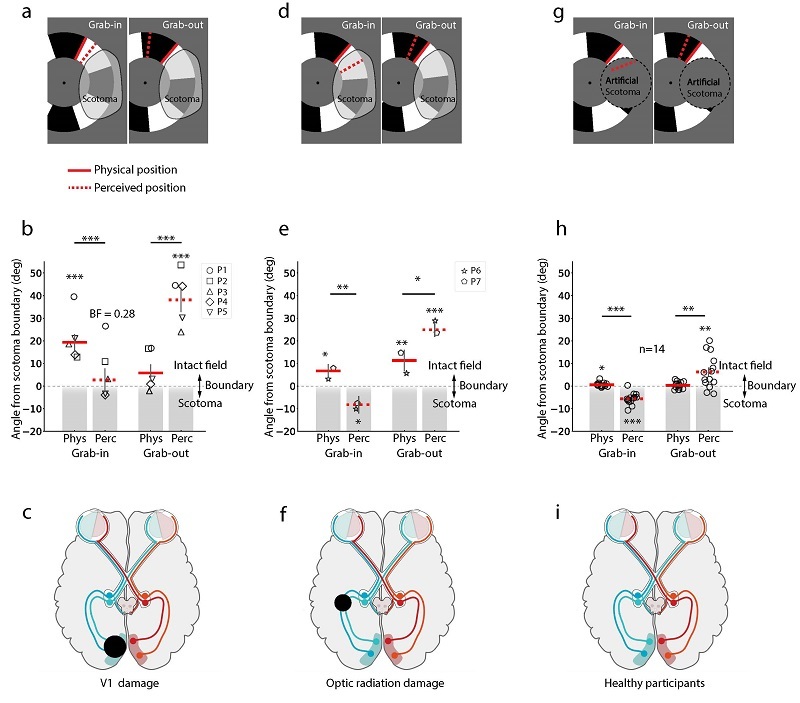
Figure 2. V1 integrity is necessary for motion-extrapolated position to reach awareness.
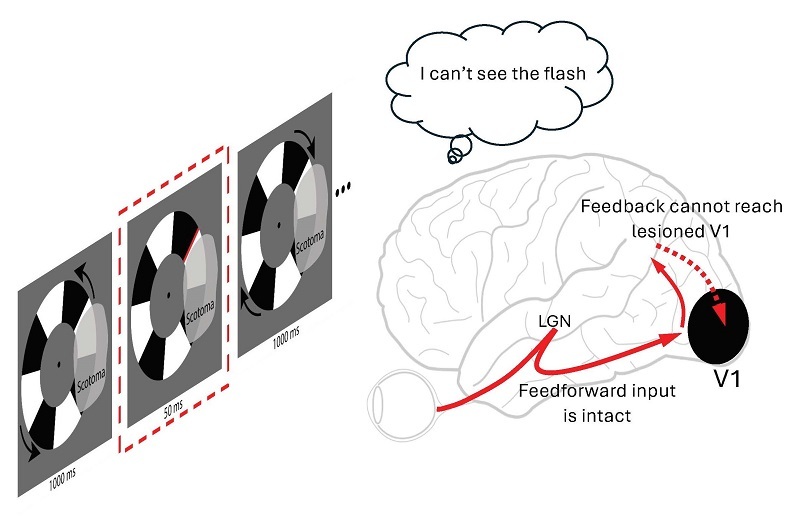
Figure 3. Loss of V1 feedback signals renders a flashed red bar invisible within the blind field.
(Image by ZHANG Peng's group)
Article link: https://doi.org/10.1016/j.csres.2026.09.002
Contact: ZHANG Peng
Institute of Biophysics, Chinese Academy of Sciences
Beijing 100101, China
E-mail: zhangpeng@ibp.ac.cn
(Reported by Prof. ZHANG Peng's group)