

Scientists Reveal How Cosignaling Receptors Dually Regulate T Cell Activation via Phase Separation
Previous studies have shown that upon antigen stimulation, the T cell receptor (TCR) can undergo phase separation with the kinase Lck to mediate rapid T cell activation. However, how cosignaling receptors regulate this process has remained unclear.
On October 21, 2026, PNAS published a study by researchers from the Institute of Biophysics of the Chinese Academy of Sciences, Zhejiang University, and Harbin Medical University Cancer Hospital, systematically elucidating how the costimulatory receptor CD28 and the coinhibitory receptor PD-1 regulate T cell activation through phase separation.
The researchers found that the costimulatory receptor CD28 can undergo phase separation with Lck. They also found that phosphorylated PD-1 can inhibit CD28/Lck phase separation. Notably, this inhibitory effect is highly dependent on the phosphorylation state of PD-1.
The results reveal an elegant dual regulatory mode: on one hand, CD28 promotes T cell activation by undergoing phase separation with Lck to form signaling condensates; on the other hand, PD-1 can competitively bind the CD28 intracellular domain (ICD) and co-condense, thereby disrupting CD28/Lck condensates and inhibiting CD28 signaling. In other words, phase separation plays a "dual role" in the CD28 signaling pathway.
The researchers used molecular dynamics simulations to characterize the interaction interface between CD28 and PD-1, identified several key binding sites, and designed a series of mutants accordingly. Experiments in a two-dimensional membrane system confirmed that phase separation between these mutants and PD-1 was significantly inhibited, while their ability to undergo phase separation with Lck remained unaffected.
They further introduced the CD28 mutants into second-generation CAR-T constructs. In vitro experiments showed that in the absence of PD-L1, mutant and wild-type CD28 CAR-T cells had comparable functions; when target cells expressed PD-L1, wild-type CD28 CAR-T cells were strongly inhibited, whereas 4-1BB- and mutant CD28-based CAR-T cells were less affected.
Furthermore, in a Raji cell-based tumor model in NSG mice, mutant CD28 CAR-T cells showed therapeutic efficacy comparable to that of 4-1BB CAR-T cells and markedly superior to that of CAR-T cells carrying the wild-type CD28 intracellular domain.
By elucidating the coupled regulatory molecular mechanisms within cosignaling receptors, this study deepens the understanding of the complex cosignaling regulatory network and provides important guidance for the rational design and optimization of CAR-T cells.
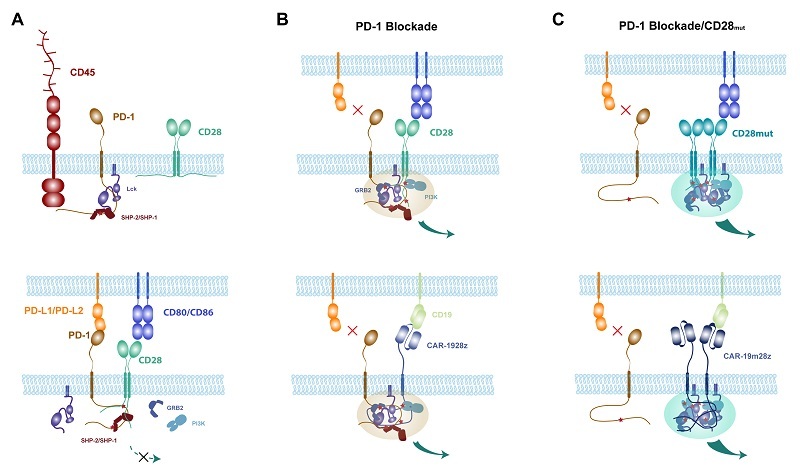
Figure. Phase separation-mediated dual regulation of T cell activation by CD28 and PD-1 and mutant decoupling strategy
A. Dual regulation under physiological conditions. B. Partial effect of ligand blockade. C. Complete relief by combined mutant blockade.
(Image by LOU Jizhong's group)
Article link: https://www.pnas.org/doi/10.1073/pnas.2612742123
Contact: LOU Jizhong
Institute of Biophysics, Chinese Academy of Sciences
Beijing 100101, China
E-mail: jlou@ibp.ac.cn
(Reported by Prof. LOU Jizhong's group)