

New Organic Iron-Sulfur Framework Boosts Photosynthesis and Carbon Fixation
Iron-sulfur clusters are ancient protein cofactors essential for electron transport, enzyme catalysis, and photosynthesis. However, their sensitivity to oxygen and inherent instability have long hindered practical applications.
Researchers from the Institute of Biophysics and the Institute of Genetics and Developmental Biology of the Chinese Academy of Sciences, have designed a condensed organic iron-sulfur framework (OISF) containing discrete iron-sulfur clusters. The material combines the electron-transfer function of iron-sulfur clusters with the stability of condensed metal-organic framework (MOF)-like structures.
The related study was published in Small on October 30, 2026.
The researchers employed a hydrothermal synthesis strategy, introducing terephthalic acid as an organic linking ligand to break up the dense lattice of conventional iron sulfide minerals. This produced a nanosheet-like framework containing discrete iron-sulfur clusters.
Using multiple characterization techniques, including X-ray diffraction structural analysis, synchrotron radiation, and Mössbauer spectroscopy, the researchers verified the structure of OISF and its [2Fe-2S] core.
Further investigation revealed that OISF possesses strong electron-transfer capability, enabling it to donate electrons to a variety of electron acceptors, with its redox process tunable through chemical conditions.
Structural analysis indicated that this electron-transfer process is associated with the dynamic formation of S-S bonds between discrete iron-sulfur clusters in adjacent layers. Compared with conventional iron sulfide minerals, OISF exhibits higher redox activity along with good oxygen stability, creating favorable conditions for its integration with biological systems.
Building on these properties, the team combined OISF with isolated chloroplasts to construct an OISF-chloroplast complex (OCC). Experimental results showed that, compared with chloroplasts alone, this complex system possesses higher carbon fixation activity.
Starting from the electron-transfer function of natural iron-sulfur clusters, this study provides new ideas for the design of biomimetic materials that balance stability and redox activity, and offers experimental and theoretical evidence for using nanozymes to enhance the efficiency of the electron transport chain in the dark reactions of photosynthesis.
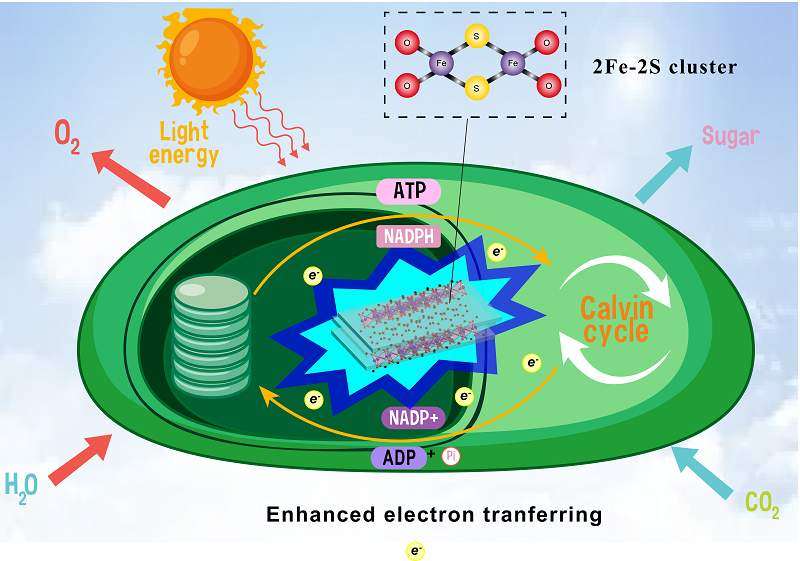
Figure 1. Construction of the organic iron-sulfur framework (OISF) and its enhancement of chloroplast dark reactions
(Image by GAO Lizeng's group)
Article link: https://doi.org/10.1002/smll.76352
Contact: GAO Lizeng
Institute of Biophysics, Chinese Academy of Sciences
Beijing 100101, China
E-mail: gaolizeng@ibp.ac.cn
(Reported by Prof. GAO Lizeng's group)