

isSPA-vesicle : A new AI-assisted algorithm for structure determination of membrane proteins on vesicles
The conformation of membrane proteins is highly sensitive to their surrounding membrane environment. Vesicular systems can not only provide membrane curvature but also enable the establishment of an ion gradient across the vesicle membrane, mimicking the physiological environment of membrane proteins. Notably, a growing number of studies have focused on structural analysis of membrane proteins reconstituted in liposomes, purified vesicles, native membrane-derived vesicles and viral envelopes. Despite advances in native membrane sample preparation, data processing still heavily relies on conventional single-particle analysis (SPA) or subtomogram averaging (STA). Nevertheless, SPA and STA suffer from limitations in either efficiency or resolution when applied to vesicular samples.
On November 16, 2026, the research group led by Prof. ZHANG Xinzheng at the Institute of Biophysics, Chinese Academy of Sciences published a research article in PNAS entitled "isSPA-vesicle: AI-assisted structure determination of membrane proteins on vesicles". The team presents an AI-enabled, vesicle geometry-guided three-dimensional reconstruction strategy based on particles detected by isSPA from untilted data. Vesicles adopt anisotropic shapes in solution and are nearly spherical or ellipsoidal. The authors trained an AI model to estimate membrane geometric parameters and calculate normal vectors from fitted ellipsoidal surfaces. The derived vesicle geometric information enables post hoc filtering of particles picked within the isSPA framework: particles are filtered according to the angular difference between their orientations and membrane normals, while free particles outside vesicles are discarded.
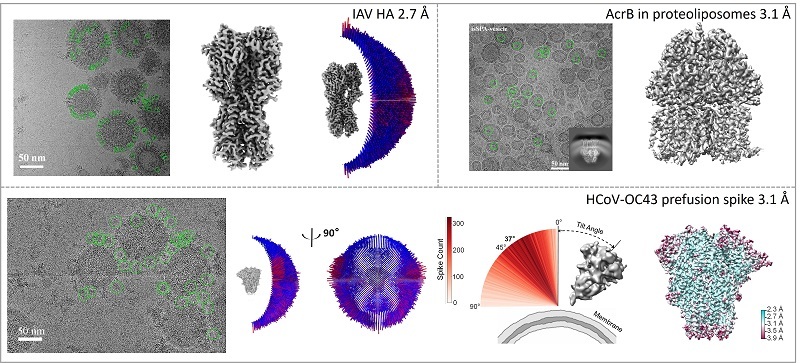
Figure: Representative applications of isSPA-vesicle, including data processing and reconstruction results for influenza A virus hemagglutinin (HA), AcrB in proteoliposomes, and the prefusion spike protein of HCoV-OC43.
(Image by ZHANG Xinzheng's group)
The results presented here demonstrate that, compared with SPA workflows using Topaz or conventional template matching (TM) for particle picking, isSPA-vesicle can accurately estimate particle positions and orientations even when membrane densities overlap. It does not depend on the molecular weight of the soluble domain and recovers more valid particles. Relative to conventional isSPA, it efficiently removes membrane-unbound particles and extends the lower molecular-weight limit amenable to isSPA reconstruction. On the AcrB validation dataset, isSPA-vesicle achieves higher reconstruction resolution than the other three methods.
Using this approach, the authors efficiently reconstructed membrane proteins with molecular weights ranging from 130 kDa to 2 MDa across two classes of enveloped viruses and three types of synthetic liposomes. They reached a resolution of 2.7 Å for influenza A virus hemagglutinin and 3.1 Å for the prefusion spike protein of human coronavirus OC43. This method provides a simple and efficient tool for such reconstructions within physiological lipid bilayers.
Article link: https://www.pnas.org/doi/10.1073/pnas.2620173123
Contact: ZHANG Xinzheng
Institute of Biophysics, Chinese Academy of Sciences
Beijing 100101, China
E-mail: xzzhang@ibp.ac.cn
(Reported by Prof. ZHANG Xinzheng's group)